CT Scan of the Head: About Your Child's Test
What is it?
A CT (computed tomography) scan uses X-rays to make detailed pictures of structures inside the body. A CT
scan of the head can give your doctor information about your child's eyes, bones of the face and nose, inner
ear, and brain.
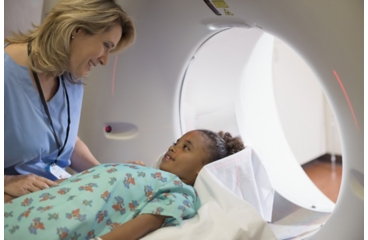
During the test, your child will lie on a moving table that is attached to the CT scanner. The CT scanner is
a large doughnut-shaped machine. The table will move in and out of the center of the machine during the scan.
If you aren't pregnant, you can stay in the room with your child during the test. You will wear an apron that
protects your body from X-rays.
Why is this test done?
A CT scan of the head can help find the cause of headaches or look for tumors or fractures or bleeding after
a head injury.
How do you prepare for the test?
-
Let your child know that a CT scan doesn't hurt.
-
If your child gets nervous in tight spaces, ask the doctor if your child will need sedation to help relax
before the test. You can also ask if your child will swallow a contrast material before the test or if your
child will have contrast materials (dye) put into an IV in the arm. The doctor will tell you if your child
should stop eating or drinking before the test.
How is the test done?
Before the test
-
Your child will take off any jewelry and most or all clothing. Your child will get a gown to wear. If your
child leaves some clothes on, make sure everything is out of the pockets.
-
The doctor may give your child medicine to help your child relax and stay still for the test.
-
Your child may get a contrast material (dye). Depending on the reason for the scan, your child may get the
dye in a drink or through a tube called an I.V. in the arm.
During the test
-
Your child will lie on a table that's attached to the CT scanner.
-
The table slides into the round opening of the scanner. The table will move during the scan. The scanner
moves within the doughnut-shaped casing around your child's body.
-
Your child will be asked to hold still during the scan. Or a safety strap or device may be used. Your
child may also be asked to hold their breath for short periods. You may need to help your child do these
things.
-
Your child will be kept safe and comfortable during the test. You may be able to stay in the room with
your child. A technologist will watch through a window and talk with your child during the test.
How does the test feel?
-
A CT scan does not hurt.
-
If the contrast dye is injected through an I.V., your child may feel a quick sting or pinch when the I.V.
is started. The dye may make your child feel warm and flushed and may cause a metallic taste in your child's
mouth. Some people feel sick to their stomach or get a headache. The technician will watch for this and give
help if needed.
How long does the test take?
The test will take about 30 to 60 minutes. Most of this time is spent getting ready for the scan. The actual
scan takes only a few minutes.
What are the risks of the test?
The chance of a CT scan causing a problem is small.
-
There is a chance of an allergic reaction to the contrast material.
-
There is a risk of damage to cells or tissue from being exposed to radiation, including the small amounts
used in CTs, X-rays, and other medical tests. Over time, exposure to radiation may cause cancer and other
health problems. But in most cases, the risk of getting cancer from being exposed to small amounts of
radiation is low. It is not a reason to avoid these tests for most people.
-
If your teen is breastfeeding and is concerned about whether the dye used in this test is safe, talk to
your teen's doctor. Most experts believe that very little dye passes into breast milk and even less is
passed on to the baby. But if your teen prefers, some breast milk may be stored ahead of time and used for a
day or two after the test.
What happens after the test?
-
Depending on the reason for the test, your child will probably be able to go home right away. If your
child is in the hospital, your child will be taken back to their room.
-
If dye was used, have your child drink lots of liquids for 24 hours after the test, unless your doctor
says not to.
Follow-up care is a key part of your child's treatment and safety. Be sure to make and go to all
appointments, and call your doctor if your child is having problems. It's also a good idea to keep a list of
the medicines your child takes. Ask your doctor when you can expect to have your child's test results.
Current as of: July 26, 2023
Content Version: 14.0
Care instructions adapted under license by your
healthcare professional. If you have questions about a medical condition or this instruction, always ask
your healthcare professional. Healthwise, Incorporated disclaims any warranty or liability for your use of
this information.