Learning About Vesicoureteral Reflux (VUR) in Newborns
What is VUR?
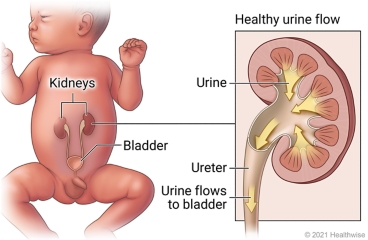
Vesicoureteral reflux (VUR) is the backward flow of urine inside the body. Urine is made by the kidneys and
is supposed to flow to the bladder through the ureters and then leave the body. But when it flows backward,
from the bladder to the kidneys, it can cause bacteria to reach your baby's kidneys. This could cause an
infection or scarring.
VUR may be a congenital problem. This means your baby was born with it. VUR ranges from mild to severe. Mild
cases often need no treatment.
How is VUR diagnosed?
Before your baby is born, a prenatal ultrasound can look for a problem with one or both of your baby's
kidneys. If a problem is seen, your newborn may have a kidney ultrasound.
If the kidney ultrasound shows that your baby might have vesicoureteral reflux (VUR), a voiding
cystourethrogram (VCUG) may be done. This is an X-ray test that takes pictures of your baby's bladder. It is
used to diagnose VUR and to find out if the problem is mild or severe.
How is VUR treated?
Many children don't need treatment for VUR. The ureters grow as a child gets older. Mild cases of VUR often
go away by the time a child is 5 years old.
With VUR, urinary tract infections (UTIs) are more likely. If your baby gets a UTI, your baby will likely be
prescribed antibiotics. Antibiotics may also be given to prevent UTIs.
Severe cases of VUR may need surgery.
What can you expect?
The hospital staff is well prepared to care for babies with this condition. They will do everything they can
to help. If you need it, ask for support from friends and family. You can also ask the hospital staff about
counseling and support.
Follow-up care is a key part of your child's treatment and safety. Be sure to make and go to all
appointments, and call your doctor if your child is having problems. It's also a good idea to know your
child's test results and keep a list of the medicines your child takes.
Current as of: November 15, 2023
Content Version: 14.0
Care instructions adapted under license by your
healthcare professional. If you have questions about a medical condition or this instruction, always ask
your healthcare professional. Healthwise, Incorporated disclaims any warranty or liability for your use of
this information.