Learning About Atypical Hyperplasia of the Breast
What is it?
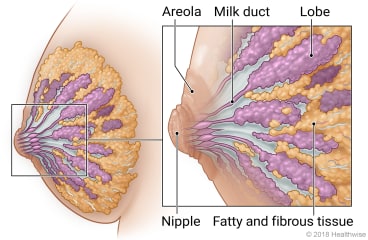
Atypical hyperplasia of the breast means that there are extra cells in the breast that are not normal. These
cells may be in the milk ducts (atypical ductal hyperplasia). Or they may be in the lobes (atypical lobular
hyperplasia). It is not cancer. But having it increases the risk of breast cancer.
What causes it?
The exact cause isn't known. Family health history may play a part.
What are the symptoms?
Usually there are no symptoms of atypical hyperplasia. The changes in breast tissue are too small to be felt.
How is it diagnosed?
It's diagnosed with a biopsy of breast tissue. This is most often done after a mammogram finds changes in
breast tissue that don't look normal.
A breast biopsy is a test to look at a small sample of tissue that has been removed from the breast. The
sample is looked at under a microscope. If you have atypical hyperplasia, the doctor can see the abnormal
cells in the sample tissue.
To take the sample, your doctor may use a needle or probe. Your doctor may need to make a small cut in the
skin to remove all or part of the area found on the mammogram.
How is it treated?
Your treatment may depend on the type of hyperplasia you have and your family history of cancer. Atypical
hyperplasia may be treated by removing the abnormal cells. These may be removed during the breast biopsy. But
in some cases, the doctor may make a small cut in the skin to take out more breast tissue.
Your doctor may have you take medicines to help prevent breast cancer. These may include tamoxifen. If you
are past menopause, the medicines may also include aromatase inhibitors.
Your doctor may have you avoid some medicines. These include birth control pills and hormone replacement
therapy. They may increase the risk of breast cancer if you have atypical hyperplasia.
You will work with your doctor to reduce your risk of breast cancer. You may have a breast exam every 6
months and a mammogram once a year. Your doctor may suggest that you have an MRI scan of the breast.
Follow-up care is a key part of your treatment and safety. Be sure to make and go to all
appointments, and call your doctor if you are having problems. It's also a good idea to know your test results
and keep a list of the medicines you take.
Current as of: October 25, 2023
Content Version: 14.0
Care instructions adapted under license by your
healthcare professional. If you have questions about a medical condition or this instruction, always ask
your healthcare professional. Healthwise, Incorporated disclaims any warranty or liability for your use of
this information.