Skin Grafts: Before Your Child's Surgery
What is skin graft surgery in children?
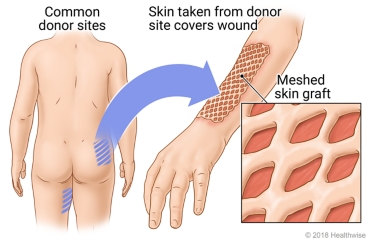
Skin grafts are small sections of healthy skin taken from one part
of the body and put on another part. They are used to treat skin
damaged by burns, infection, or injury. When possible, the doctor
takes the healthy skin from a place that's hard to see or is often
covered by clothes.
In many cases, skin grafts only use the top layer of skin. This is
called a split-thickness graft. When more layers are needed, it's
called a full-thickness graft. The kind your child needs depends on
how much damage there is and where it is.
In a split-thickness graft, the doctor removes a strip of healthy
skin with a special tool. This "donor" skin usually comes from the
inner thigh or the rear end (buttocks). Then the doctor puts the
strip on the damaged area and attaches it with stitches or staples.
If the area is large, the doctor may "mesh" the donor skin. Meshing
is a process to make small cuts in the donor skin. These cuts allow
the donor skin to stretch to cover the graft area. Meshing makes it
possible to cover a larger area with a smaller amount of donor skin.
Several strips of donor skin may be used to cover larger areas. Your
child will grow a new layer of skin in the place where the donor
skin was removed.
In a full-thickness graft, only small pieces of skin are used. This
is because the skin doesn't grow back where it was removed, and the
edges have to be stitched together. Skin for this type of graft
usually comes from the upper arm or lower belly. But other areas may
be used to best match the color or texture of the area that needs
the graft.
Your child will get medicine to make your child sleep during
surgery. After surgery, your child will have a bandage over the
graft. The doctor will remove this in 4 to 10 days. The stitches or
staples will be removed in 7 to 10 days.
For small grafts, your child may be able to go home the same day.
For large grafts or ones in difficult areas, your child may need to
stay in the hospital for a few days or more.
How do you prepare for surgery?
Surgery can be stressful for both your child and you. This
information will help you understand what you can expect. And it
will help you safely prepare for your child's surgery.

Preparing for surgery
|
|
|
|
|
|
|
|
|
|
|
|
|
|
-
Tell the doctor ALL the medicines, vitamins, supplements,
and herbal remedies your child takes. Some may increase
the risk of problems during the surgery. Your doctor will
tell you if your child should stop taking any of them
before the surgery and how soon to do it.
|
What happens on the day of surgery?
-
Follow the instructions exactly about when your child should stop
eating and drinking. If you don't, your child's surgery may be
canceled. If your doctor told you to have your child take any
medicines on the day of surgery, have your child take them with
only a sip of water.
-
Follow the doctor's instructions about when your child should
bathe or shower before the surgery. Do not apply lotion or
deodorant.
-
Your child may brush their teeth. But tell your child not to
swallow any toothpaste or water.
-
Do not let your child wear contact lenses. Bring your child's
glasses or contact lens case.
-
Be sure your child has something that's a reminder of home. A
special stuffed animal, toy, or blanket may be comforting. For an
older child, it might be a book or music.
At the hospital or surgery center
-
A parent or legal guardian must accompany your child.
-
Your child will be kept comfortable and safe by the anesthesia
provider. Your child will be asleep during the surgery.
-
How long it takes to do the skin graft depends on how much damaged
skin needs to be covered.
-
After surgery, your child will be taken to the recovery room. As
your child wakes up, the recovery staff will monitor your child's
condition. The doctor will talk to you about the surgery.
-
Your child will have bandages over the graft area and the area
where the skin was taken from.
-
You may be able to take your child home on the same day as the
surgery. Or your child may need to stay in the hospital for a few
days or more.
When should you call your doctor?
Current as of: September 20, 2023
Content Version: 14.0
Care instructions adapted under license by your healthcare
professional. If you have questions about a medical condition or
this instruction, always ask your healthcare professional.
Healthwise, Incorporated disclaims any warranty or liability for
your use of this information.