Tunneled Catheter: Before Your Child's Procedure
What is tunneled catheter placement?
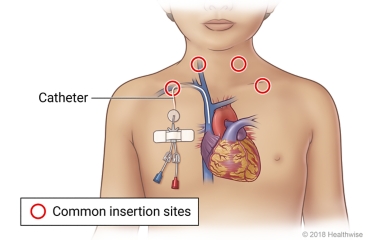
A tunneled catheter is a soft, flexible tube that runs under your
child's skin from a vein in your child's chest or neck to a large
vein near the heart. This catheter is a type of central vascular
access device.
The catheter is used to give your child medicine, fluids, nutrients,
or blood products for up to several weeks or more. The fluids are
put through the central line so that they move quickly into your
child's bloodstream. The same line can be used for a while, so your
child isn't poked with a needle every time.
The line also can be used to take out blood for tests.
Usually a short section of the line stays outside of the body. The
place where the line leaves the skin is called the exit site.
Sometimes the line has two or three ends so your child can get more
than one medicine at a time. These ends are called lumens. The end
of each lumen is covered with a cap.
Before placing the catheter, the doctor may give your child medicine
to sleep or feel relaxed. Your child may feel a little pain when the
doctor gives the medicine. The doctor will then insert the catheter.
How do you prepare for the procedure?
Procedures can be stressful for both your child and you. This
information will help you understand what you can expect. And it
will help you safely prepare for your child's procedure.

Preparing for the procedure
|
|
|
|
|
|
|
|
-
Tell the doctor ALL the medicines, vitamins, supplements,
and herbal remedies your child takes. Some may increase
the risk of problems during the procedure. Your doctor
will tell you if your child should stop taking any of them
before the procedure and how soon to do it.
|
|
|
|
|
|
|
The day before the procedure
What happens on the day of the procedure?
|
|
-
Follow the instructions exactly about when your child
should stop eating and drinking. If you don't, the
procedure may be canceled. If your doctor told you to have
your child take any medicines on the day of the procedure,
have your child take them with only a sip of water.
|
|
|
|
|
|
|
|
|
|
|
|
-
Be sure your child has something that's a reminder of
home. A special stuffed animal, toy, or blanket may be
comforting. For an older child, it might be a book or
music.
|

At the hospital
or surgery center
When should you call your doctor?
Current as of: July 26, 2023
Content Version: 14.0
Care instructions adapted under license by your healthcare
professional. If you have questions about a medical condition or
this instruction, always ask your healthcare professional.
Healthwise, Incorporated disclaims any warranty or liability for
your use of this information.