Tunneled Catheter in Children: What to Expect at Home
Your Child's Recovery
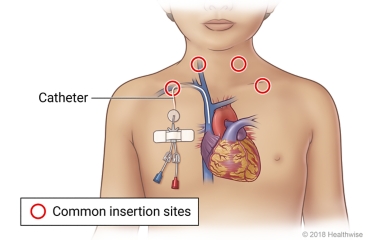
Your child had a procedure to place a tunneled catheter. The catheter is a soft, flexible tube that runs under your child's skin, usually from a vein in the chest or neck to a large vein near the heart. Your child may have it for weeks, months, or longer.
Your child will now be able to get medicine, blood, nutrients, or other fluids with more comfort. Your child will not be poked with a needle every time.
You can use your child's catheter right away. You will be shown how to use it and how to care for it.
Your child's doctor will tell you how to care for the incision at the insertion site. (It's usually on your child's neck.) It may have stitches, strips of tape, or a gauze dressing. Your doctor will tell you when the stitches will be removed. The strips of tape will fall off in 3 to 5 days. The gauze dressing can be removed after 2 days.
The doctor will tell you how to care for the incision on your child's chest where the catheter is. It will likely have a clear or gauze dressing on it. A clear dressing usually needs to be changed about 2 days after the procedure and then once a week. A gauze dressing needs to be changed 2 or 3 times a week. Also, change the dressing right away if it becomes wet, loose, or dirty.
Under the skin, there may be a small ring, or cuff, on the catheter. This helps hold the catheter in place.
This care sheet gives you a general idea about how long it will take for your child to recover. But each child recovers at a different pace. Follow the steps below to help your child get better as quickly as possible.
How can you care for your child at home?
Activity
|

|
|
|
|
|
|
|
-
Your child will probably need to take 1 day off from school and will be able to return to normal activities shortly after. This depends on the type of activities your child does, why your child has the catheter, and how your child feels.
|
|
|
|
Medicines
Incision care
|

|
-
Your child's doctor will tell you how to care for the incision at the insertion site. (It's usually on your child's neck.) It may have stitches, strips of tape, or a gauze dressing. Your doctor will tell you when the stitches will be removed. The strips of tape will fall off in 3 to 5 days. The gauze dressing can be removed after 2 days.
|
|
|
-
Your child's doctor will tell you how to care for the incision on your child's chest where the catheter is. It will likely have a clear or gauze dressing on it. A clear dressing usually needs to be changed about 2 days after the procedure and then once a week. A gauze dressing needs to be changed 2 or 3 times a week. Also, change the dressing right away if it becomes wet, loose, or dirty.
|
Other instructions
|

|
|
|
|
|
|
|
|
|
|
-
If the catheter breaks, follow the instructions your doctor gave you. If you have no instructions, clamp or tie off the catheter. Then see a doctor as soon as you can. Talk to the nurse or other care giver about an emergency kit to use if the catheter breaks.
|
|
|
|
|
|
|
|
|
|
|
|
|
|
|
|
|
|
|
|
|
|
|
|
|
|
|
|
|
|
|
Follow-up care is a key part of your child's treatment and safety. Be sure to make and go to all appointments, and call your doctor if your child is having problems. It's also a good idea to know your child's test results and keep a list of the medicines your child takes.
When should you call for help?
 Call 911 anytime you think your child may need emergency care. For example, call if:
Call your doctor now or seek immediate medical care if:
Watch closely for changes in your child's health, and be sure to contact your doctor if:
Current as of: July 26, 2023
Content Version: 14.0
Care instructions adapted under license by your healthcare professional. If you have questions about a medical condition or this instruction, always ask your healthcare professional. Healthwise, Incorporated disclaims any warranty or liability for your use of this information.