Health Encyclopedia
Search Clinical Content Search Patient Health Library
A B C D E F G H I J K L M N O P Q R S T U V W X Y Z A-Z Listings

Pin Care in Children: What to Expect at Home

Your Child's Recovery
../images/a2ff40643bb5761b7c4b919f8cde9b49.jpg

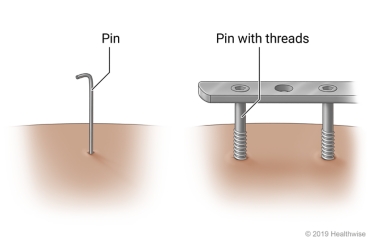
To hold your child's bone in place as it heals, your doctor inserted one or more pins into the bone. Some pins are like thick wires. Others are more like screws. In some cases, the pins are attached to an external fixator. This device helps hold your child's bone in place from outside the body.

Pins may stay in place until the bone is healed. Your doctor will tell you how long the pins will be needed.

The places where the pins go into the skin are called the pin sites. These areas must be kept clean to prevent infection. An infection could make a pin become loose or even require your doctor to take out a pin.

This care sheet gives you a general idea about how long it will take for your child to recover. But each child recovers at a different pace. Follow the steps below to help your child get better as quickly as possible.

How can you care for your child at home?

Pin care

Your doctor will give you specific information about when and how to clean your child's pin sites. The following is general information.


  1. Wash your hands with soap and water.


  1. Get your cleaning supplies ready. Your doctor will tell you what to use. These supplies usually include:

    • A cleaning solution.

    • Cups to hold the solution.

    • Cotton swabs.

    • Cotton gauze.


  1. Wash your hands again.


  1. Use your fingers to gently massage the area around the pin. This can move skin attached to the pin away from the pin and help any fluid rise to the skin, where you can clean it.


  1. Clean each pin site with cotton swabs. Use a new swab for each pin site.

    • Dip the swab in the cleaning solution.

    • Clean the pin site. Circle around the site, moving away from the pin. If there is any crust around the pin, remove it with the swab. Use as many swabs as you need until the site is clean.

    • Dry the area with a new swab.


  1. Clean the pin with a swab or gauze dipped in the cleaning solution. Pay close attention to any threaded area on the pin. Use a new swab or piece of gauze for each pin.


  1. For the first few days, wrap gauze loosely around each pin site.


  1. If your child has a fixator, use gauze or cotton swabs dipped in the cleaning solution to clean the fixator and any wires that connect it to the pins.

../images/Instructions_icn.jpg

Other instructions


  • Your doctor will tell you when and how you can bathe your child. In general, the pin sites need to be kept dry for a while after they have been put in place. Ask your doctor if and when your child can swim while the pins are in.


  • Prop up the affected area on a pillow, if the pin is on your child's arm or leg. Try to keep it above the level of the heart. This will help reduce swelling.


  • Urge your child to be careful when moving around. Your child should try not to bump or snag the pin or fixator on anything. The doctor may give you specific instructions on what your child can and can't do.


  • Avoid clothing that pulls or rubs on the pin or fixator. If you can, have your child not wear clothing over it. Teach your child to be careful when getting dressed so that clothing doesn't catch on it.

Follow-up care is a key part of your child's treatment and safety. Be sure to make and go to all appointments, and call your doctor if your child is having problems. It's also a good idea to know your child's test results and keep a list of the medicines your child takes.

When should you call for help?

../images/Call-for-help_icn.jpgCall 911 anytime you think your child may need emergency care. For example, call if:


  • Your child passes out (loses consciousness).


  • Your child has chest pain, is short of breath, or coughs up blood.

Call your doctor now or seek immediate medical care if:


  • Your child has symptoms of infection, such as:

    • Increased pain, swelling, warmth, or redness.

    • Red streaks leading from any incision or pin site.

    • Pus draining from any incision or pin site.

    • A fever.


  • Your child has tingling, weakness, or numbness around the pin area.


  • Your child's splint, if they have one, feels too tight.


  • Your child has signs of a blood clot in the leg (called a deep vein thrombosis), such as:

    • Pain in the calf, back of the knee, thigh, or groin.

    • Swelling in the leg or groin.

    • A color change on the leg or groin. The skin may be reddish or purplish, depending on your child's usual skin color.

Watch closely for changes in your child's health, and be sure to contact your doctor if:


  • Your child has new or increased pain.


  • You notice that the pin or any part of the fixator seems loose or out of place.


  • There is bleeding around a pin site that won't stop.


  • Your child also has a splint, and there's drainage or a bad smell coming from it.

Current as of: July 17, 2023

Content Version: 14.0

Care instructions adapted under license by your healthcare professional. If you have questions about a medical condition or this instruction, always ask your healthcare professional. Healthwise, Incorporated disclaims any warranty or liability for your use of this information.

© 2006-2026 Healthwise, Incorporated.
Powered by Krames by WebMD Ignite

These resources and their content are provided by a third party for informational purposes and do not necessarily reflect the values and positions of Ascension, its ministries, or its subsidiaries.

About StayWell | Terms of Use | Privacy Policy | Disclaimer

The Services may integrate with Third-Party Apps or contain third-party content or provide links to third-party websites. For example, the Services may integrate with Third-Party App providers to provide you with information. You authorize Ascension to transmit information about You to and receive information about You from applicable third parties.
You agree that Ascension is not responsible for Third-Party Apps, third-party content or third-party websites, and does not make any endorsements, representations or warranties regarding the same. Your use thereof is at Your own risk and subject to the third party’s terms and conditions, as applicable. By using a Third-Party App or third-party content or websites, You agree to the applicable third party’s terms and conditions, even if Ascension does not present them to You at the time of Your use.