When Your Child Needs Total Parenteral Nutrition (TPN)
Total parenteral nutrition (TPN) is a way for your child to get correct nutrition. This is done using a small, soft tube called a catheter. At the hospital, the catheter is put into your child's vein. This allows liquid nutrition to be put into your child’s blood vessels. After the catheter is in place, you may be able to give TPN to your child at home. A home care nurse can teach you how. You’ll also learn how to clean and care for the catheter site.
Why is TPN needed?
TPN may be used when:
-
Your child's body can't digest regular foods.
-
Your child can't eat enough food to meet the body's needs.
-
Your child has problems with the digestive tract, such as ulcerative colitis or a blockage.
Types of TPN lines
There are two main types of TPN lines used:
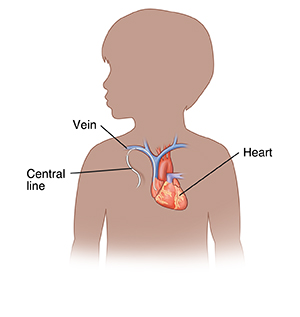
Central line. This kind of line is often used for babies and very young children. The catheter is placed into a vein in the neck or chest.
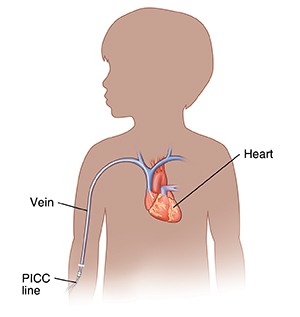
Peripherally inserted central catheter (PICC) line. This type of line is often placed into a vein in your child’s arm. The line is gently threaded through the vein up to the heart.
When to contact the doctor
Contact the doctor right away if:
-
The tubing splits, leaks, is blocked, or comes out part way or all the way.
-
Fluid is leaking from the site where the catheter enters the body.
-
Your child has a fever over 100.4°F ( 38°C), or as told by the doctor.
-
Your child has trouble breathing.
-
Your child is vomiting.
-
Your child's skin or the whites of their eyes turn yellow (jaundice).
-
Your child has swelling in the hand, arm, back, or torso.
-
There are problems at the site where the catheter enters the body. These can include:
-
Pain, redness, swelling, or warmth.
-
Bleeding.
-
Bulging of the skin, or the skin pulling away from the catheter.
Online Medical Reviewer:
Chelsey Schilling BSN RN
Online Medical Reviewer:
Daphne Pierce-Smith RN MSN
Online Medical Reviewer:
Lalitha Kadali
Date Last Reviewed:
6/1/2025
© 2000-2026 The StayWell Company, LLC. All rights reserved. This information is not intended as a substitute for professional medical care. Always follow your healthcare professional's instructions.