Related Reading
Search Clinical Content Search Patient Health Library
A B C D E F G H I J K L M N O P Q R S T U V W X Y Z A-Z Listings

Splenectomy in Children: What to Expect at Home

Your child's recovery
../images/a1550611aae87f06b59ea234c274d2fb.jpg

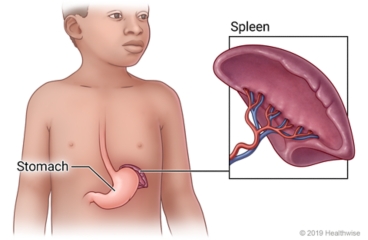
A splenectomy (say "splih-NEK-tuh-mee") is surgery to take out the spleen. After a splenectomy, your child is likely to have pain for several days. Some children feel like they have the flu. Your child may have a low fever and feel tired and nauseated. This is common. Your child should feel better after a few days and will probably feel much better in about a week.

The spleen helps protect your child against infections. Now that the spleen has been removed, your child may need one or more vaccinations to prevent infections. Your child can get these vaccines in the weeks after surgery.

Your child may need to take antibiotics for a while after surgery and each time your child has a fever. This could be a sign of a serious infection. Ask the doctor what to do if your child has a fever.

This care sheet gives you a general idea about how long it will take for your child to recover. But each child recovers at a different pace. Follow the steps below to help your child get better as quickly as possible.

How can you care for your child at home?

../images/Return-to-activity_icn.jpg

Activity


  • Have your child rest when he or she feels tired.


  • Have your child try to walk a little each day. Make each walk a little longer than the day before.


  • Your child should not ride a bike, play running games, or take part in gym class until your doctor says it is okay.


  • Your child may shower 24 to 48 hours after surgery, if your doctor okays it. Pat the incision dry. Do not let your child take a bath for 1 week, or until your doctor tells you it is okay.

../images/Diet_icn.jpg

Diet


  • Your child can eat a normal diet. If your child's stomach is upset, try bland, low-fat foods like plain rice, broiled chicken, toast, and yogurt.


  • Have your child drink plenty of fluids to avoid becoming dehydrated.


  • You may notice a change in your child's bowel habits right after surgery. You can help him or her to avoid constipation and straining. Have your child drink plenty of water. The doctor may suggest fiber, a stool softener, or a mild laxative.

../images/Medicines_icn.jpg

Medicines


  • Be safe with medicines. Read and follow all instructions on the label.

    • If the doctor gave your child a prescription medicine for pain, give it as prescribed.

    • If your child is not taking a prescription pain medicine, ask the doctor if your child can take an over-the-counter medicine.


  • If the doctor prescribed antibiotics for your child, give them as directed. Do not stop using them just because your child feels better. Your child needs to take the full course of antibiotics.


  • Your doctor will tell you if and when your child can restart his or her medicines. The doctor will also give you instructions about your child taking any new medicines.

../images/Incision-care_icn.jpg

Incision care


  • Your child will go home with a bandage and stitches or staples over the cut (incision) the doctor made. Your doctor may remove your child's stitches or staples 10 to 14 days after the surgery. If your child has stitches that dissolve in the body over time, the doctor will not need to take them out. Your doctor will tell you if your child needs to come back to have any stitches removed.


  • If your child has strips of tape on the incision the doctor made, leave the tape on for a week or until it falls off.


  • You may cover the area with a gauze bandage if it oozes fluid or rubs against clothing.


  • Change the bandage every day.


  • Wash the area daily with warm water, and pat it dry. Don't use hydrogen peroxide or alcohol. They can slow healing.


  • Keep the area clean and dry.

../images/Instructions_icn.jpg

Preventing infections


  • You will need to take steps to avoid infections in your child. Without a spleen, your child has a higher chance of getting very sick with some infections.

    • If your child did not get all the vaccinations they need before surgery, be sure they get all the vaccines the doctor recommends in the weeks after surgery.

    • Your child may need to take antibiotics each time he or she has a fever. This could be a sign of a serious infection. Ask the doctor what to do if your child has a fever.

    • Do not have your child travel to areas where he or she could get serious infections such as malaria.

    • Have your child avoid contact with people who are sick.

    • Have your child wash his or her hands often.

Follow-up care is a key part of your child's treatment and safety. Be sure to make and go to all appointments, and call your doctor if your child is having problems. It's also a good idea to know your child's test results and keep a list of the medicines your child takes.

When should you call for help?

../images/Call-for-help_icn.jpg Call 911 anytime you think your child may need emergency care. For example, call if:


  • Your child passes out (loses consciousness).


  • Your child has severe trouble breathing.


  • Your child has symptoms of a blood clot in the lung (called a pulmonary embolism). These may include:

    • Sudden chest pain.

    • Trouble breathing.

    • Coughing up blood.

Call your doctor now or seek immediate medical care if:


  • Your child has pain that does not get better after he or she takes pain medicine.


  • Your child has loose stitches, or the incision comes open.


  • Your child has signs of infection, such as:

    • Increased pain, swelling, warmth, or redness.

    • Red streaks leading from the incision.

    • Pus draining from the incision.

    • A fever.


  • Your child is sick to his or her stomach or cannot drink fluids.


  • Your child has symptoms of a blood clot in the leg (called a deep vein thrombosis), such as:

    • Pain in the calf, back of the knee, thigh, or groin.

    • Redness and swelling in the leg.


  • Bright red blood has soaked through the bandage.


  • Your child cannot pass stool or gas.

Watch closely for any changes in your child's health, and be sure to contact your doctor if:


  • Your child has not had a bowel movement after a couple of days.


  • Your child does not get better as expected.

Current as of: July 26, 2023

Content Version: 14.0

Care instructions adapted under license by your healthcare professional. If you have questions about a medical condition or this instruction, always ask your healthcare professional. Healthwise, Incorporated disclaims any warranty or liability for your use of this information.

© 2006-2026 Healthwise, Incorporated.
Powered by Krames by WebMD Ignite

These resources and their content are provided by a third party for informational purposes and do not necessarily reflect the values and positions of Ascension, its ministries, or its subsidiaries.

About StayWell | Terms of Use | Privacy Policy | Disclaimer

The Services may integrate with Third-Party Apps or contain third-party content or provide links to third-party websites. For example, the Services may integrate with Third-Party App providers to provide you with information. You authorize Ascension to transmit information about You to and receive information about You from applicable third parties.
You agree that Ascension is not responsible for Third-Party Apps, third-party content or third-party websites, and does not make any endorsements, representations or warranties regarding the same. Your use thereof is at Your own risk and subject to the third party’s terms and conditions, as applicable. By using a Third-Party App or third-party content or websites, You agree to the applicable third party’s terms and conditions, even if Ascension does not present them to You at the time of Your use.