Hernia Repair: Before Your Child's Surgery
What is a hernia repair?
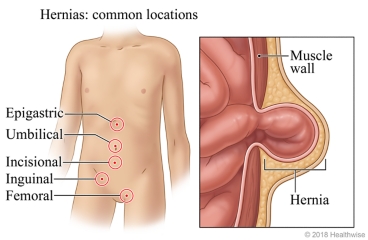
Most hernias are a weak spot in the belly muscles. This weakness can
allow a piece of the intestines or the tissue around them to poke
through. A hernia may hurt when your child strains with a bowel
movement or lifts something heavy. It may also hurt when your child
is active. But some hernias don't cause pain.
Sometimes an organ or tissue gets stuck in the hernia. This can
cause serious problems. A hernia repair prevents that from
happening.
There are several types of hernias. Umbilical hernias occur when
intestine, fat, or fluid pushes through a weak spot in the belly
near the belly button. Other types of hernias in the belly include
epigastric (near the stomach), ventral (in the middle of the belly),
and incisional (where a surgical cut was made). Inguinal and femoral
hernias occur in the groin area. Some babies are born with a
diaphragmatic hernia. It's an opening in the large muscle
(diaphragm) between the lungs and belly.
A doctor can fix a hernia through a cut (incision). This is called
open surgery. Or the doctor may make some small cuts and use a thin,
lighted scope and small tools. This is laparoscopic surgery. If your
child's hernia is bulging, the bulge is pushed back into place. The
doctor then sews the healthy tissue back together. Sometimes a piece
of material is used to patch the weak spot.
Open surgery will leave a bigger scar. Laparoscopic surgery leaves a
few small scars. The scars will fade with time.
The time it takes for your child to heal depends on the type of
hernia. Your doctor will tell you when your child can return to
normal activity.
How do you prepare for surgery?
Surgery can be stressful for both your child and you. This
information will help you understand what you can expect. And it
will help you safely prepare for your child's surgery.

Preparing for surgery
|
|
|
|
|
|
|
|
|
|
|
|
|
|
-
Tell the doctor ALL the medicines, vitamins, supplements,
and herbal remedies your child takes. Some may increase
the risk of problems during the surgery. Your doctor will
tell you if your child should stop taking any of them
before the surgery and how soon to do it.
|
The day before surgery
What happens on the day of surgery?
-
Follow the instructions exactly about when your child should stop
eating and drinking. If you don't, the surgery may be canceled. If
the doctor told you to have your child take his or her medicines
on the day of surgery, have your child take them with only a sip
of water.
-
See that your child has bathed. Do not apply lotion or deodorant.
-
Your child may brush his or her teeth. But tell your child not to
swallow any toothpaste or water.
-
Do not let your child wear contact lenses. Bring your child's
glasses or contact lens case.
-
Be sure your child has something that reminds him or her of home.
A special stuffed animal, toy, or blanket may be comforting. For
an older child, it might be a book or music.
At the hospital or surgery center
-
A parent or legal guardian must accompany your child.
-
Your child will be kept comfortable and safe by the anesthesia
provider. Your child will be asleep during the surgery.
-
The surgery can take about 30 minutes to 2 hours or more.
-
After surgery, your child will be taken to the recovery room. As
your child wakes up, the recovery room staff will monitor his or
her condition. The doctor will talk to you about the surgery.
-
Depending on the type of surgery, you may be able to take your
child home after the surgery. For more involved surgeries, your
child may stay in the hospital for a few days.
When should you call your doctor?
Current as of: July 26, 2023
Content Version: 14.0
Care instructions adapted under license by your healthcare
professional. If you have questions about a medical condition or
this instruction, always ask your healthcare professional.
Healthwise, Incorporated disclaims any warranty or liability for
your use of this information.