Related Reading
Search Clinical Content Search Patient Health Library
A B C D E F G H I J K L M N O P Q R S T U V W X Y Z A-Z Listings

Cystoscopy: Before Your Child's Procedure

What is a cystoscopy?
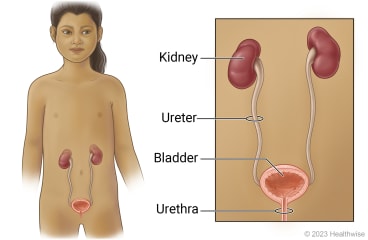
Image

A cystoscopy is a procedure that lets a doctor look inside your child's bladder and urethra. The urethra is the tube that carries urine from the bladder to outside the body.

The doctor uses a thin, lighted tool called a cystoscope (scope). The doctor puts the scope into your child's urethra and moves it into the bladder. Next, the doctor fills the bladder with liquid. This helps the doctor see better.

The doctor may also do a ureteroscopy. This procedure uses a scope to look inside a ureter. (Ureters are tubes that carry urine from the kidneys to the bladder.) This may be done if there is a problem, such as a blockage. The blockage could be from abnormal tissue, a kidney stone, or a tumor. The doctor may remove the blockage.

The doctor may take samples of tissue (biopsy) during this procedure. There may be a small amount of blood in your child's urine for several days from the biopsy. The doctor may place a thin, hollow tube (stent) in a ureter to help urine pass from the kidney to the bladder. If your child has a stent, your doctor will tell you when and how it will be removed. The doctor may also discuss other treatments, if needed.

Your child may need a catheter. This is a tube that drains urine from the bladder. If your child goes home with a catheter, your doctor will take it out at your child's follow-up visit.

Your child will get medicine to make them sleep during the procedure.

How do you prepare for the procedure?

Procedures can be stressful for both your child and you. This information will help you understand what you can expect. And it will help you safely prepare for your child's procedure.

Image

Preparing for the procedure


  • If your child is old enough, talk to your child about the procedure. Tell your child that it will help the doctor find and fix a problem inside your child's urethra and bladder. Hospitals know how to take care of children. The staff will do all they can to make it easier for your child.


  • Understand exactly what procedure is planned, along with the risks, benefits, and other options.


  • Tell the doctor ALL the medicines, vitamins, supplements, and herbal remedies your child takes. Some may increase the risk of problems during the procedure. Your doctor will tell you if your child should stop taking any of them before the procedure and how soon to do it.


  • Ask if a special tour of the surgery area and hospital is available. This may make your child feel less nervous about what happens.


  • Plan for your child's recovery time. Your child may need more of your time right after the procedure, both for care and for comfort.

The day before the procedure


  • A nurse may call you (or you may need to call the hospital). This is to confirm the time and date of your child's procedure and answer any questions.


  • Remember to follow your doctor's instructions about your child taking or stopping medicines before the procedure. This includes over-the-counter medicines.

What happens on the day of the procedure?


  • Follow the instructions exactly about when your child should stop eating and drinking. If you don't, the procedure may be canceled. If your doctor told you to have your child take any medicines on the day of the procedure, have your child take them with only a sip of water.


  • Follow the doctor's instructions about when your child should bathe or shower before the procedure. Do not apply lotion or deodorant.


  • Your child may brush their teeth. But tell your child not to swallow any toothpaste or water.


  • Do not let your child wear contact lenses. Bring your child's glasses or contact lens case.


  • Be sure your child has something that's a reminder of home. A special stuffed animal, toy, or blanket may be comforting. For an older child, it might be a book or music.

Image

At the hospital or surgery center


  • A parent or legal guardian must accompany your child.


  • Your child will be kept comfortable and safe by the anesthesia provider. Your child will be asleep during the procedure.


  • The procedure may take up to 30 minutes, or longer if other procedures are done at the same time.


  • After the procedure, your child will be taken to the recovery room. As your child wakes up, the recovery staff will monitor your child's condition. The doctor will talk to you about the procedure.


  • You will probably be able to take your child home a couple of hours after the procedure.

When should you call your doctor?

Image

  • You have questions or concerns.


  • You don't understand how to prepare your child for the procedure.


  • Your child becomes ill before the procedure (such as fever, flu, or a cold).


  • You need to reschedule or have changed your mind about your child having the procedure.

Where can you learn more?

Go to https://www.healthwise.net/patientEd

Enter B568 in the search box to learn more about "Cystoscopy: Before Your Child's Procedure."

Current as of: November 15, 2023

Content Version: 14.0

Care instructions adapted under license by your healthcare professional. If you have questions about a medical condition or this instruction, always ask your healthcare professional. Healthwise, Incorporated disclaims any warranty or liability for your use of this information.

© 2006-2026 Healthwise, Incorporated.
Powered by Krames by WebMD Ignite

These resources and their content are provided by a third party for informational purposes and do not necessarily reflect the values and positions of Ascension, its ministries, or its subsidiaries.

About StayWell | Terms of Use | Privacy Policy | Disclaimer

The Services may integrate with Third-Party Apps or contain third-party content or provide links to third-party websites. For example, the Services may integrate with Third-Party App providers to provide you with information. You authorize Ascension to transmit information about You to and receive information about You from applicable third parties.
You agree that Ascension is not responsible for Third-Party Apps, third-party content or third-party websites, and does not make any endorsements, representations or warranties regarding the same. Your use thereof is at Your own risk and subject to the third party’s terms and conditions, as applicable. By using a Third-Party App or third-party content or websites, You agree to the applicable third party’s terms and conditions, even if Ascension does not present them to You at the time of Your use.